Endpoint Detection & Response (EDR)
Seeing, investigating and stopping attacks on the servers that run the business
See, investigate and stop attacks on Linux servers today; desktop EDR is in development.
Contents
- 1Executive summary
- 2The challenge
- 3Architecture
- 4How it works
- 5Capabilities in detail
- 6Security and data handling
- 7Where it fits
- 8Deployment and system requirements
- 9Technical specifications
- 10Getting started
1Executive summary
ThreatTrace collects activity on Linux servers, detects the attacks that hit servers — crypto-miners, web shells, SSH compromise — joins them into incidents with a timeline and responds behind your approval rules, with every action on a verifiable audit trail.
2The challenge
Servers that run the business — web, application and database hosts — are where attackers mine crypto, plant web shells and move in over stolen SSH keys. Antivirus alone does not show what happened, in what order, or stop it with a record of who decided.
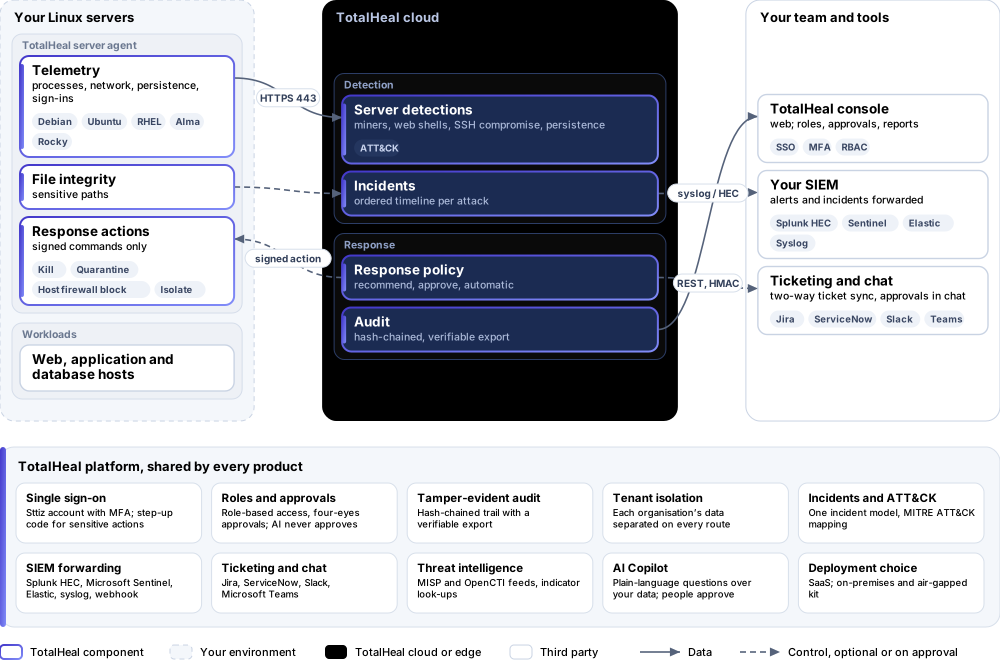
The TotalHeal approach. ThreatTrace collects process, network, persistence, file-integrity and sign-in activity on each Linux server, detects attacks mapped to MITRE ATT&CK, joins them into incidents with a timeline, and responds behind your approval rules.
3Architecture
4How it works
- CollectProcesses, connections, persistence, file integrity and sign-ins.
- DetectServer attack patterns mapped to MITRE ATT&CK.
- CorrelateRelated detections become one incident with a timeline.
- RespondKill, quarantine, block or isolate, as your policy allows.
5Capabilities in detail
- Server telemetryProcesses, network connections, persistence (services, cron, startup), file integrity of sensitive paths and sign-ins, from the TotalHeal server agent.
- Detections that matter on serversCrypto-miners, web shells, SSH compromise and suspicious persistence, each mapped to a MITRE ATT&CK technique.
- Incidents with a timelineRelated detections are joined into one incident with an ordered timeline of what ran, what connected and what changed.
- Response with approvalKill a process, quarantine a file, block an address in the host firewall or isolate the server — automatic, approved or recommended, as your response policy says.
- Tamper-evident auditEvery response request, approval and result lands in a hash-chained audit you can export and verify.
- A licence of its ownA ThreatTrace licence alone is enough on a Linux server; no desktop agent and no other TotalHeal product is needed.
6Security and data handling
- Signed commands onlyThe agent acts only on signed commands from your organisation.
- Approval for impactIsolation and other high-impact actions follow your approval rules.
- Verifiable auditEvery request, approval and result on a hash-chained audit.
7Where it fits
8Deployment and system requirements
Protected platforms
- Ubuntu20.04, 22.04, 24.04
- Debian11, 12
- Red Hat Enterprise Linux8, 9
- Rocky Linux8, 9
- AlmaLinux8, 9
On-premises server
- Operating system
- RHEL, Rocky Linux or AlmaLinux 8 / 9; Ubuntu 20.04, 22.04 or 24.04; Debian 11 / 12
- Processor
- 4 vCPU (tested configuration)
- Memory
- 8 GB recommended (6 GB minimum)
- Disk
- 10 GB free for software, releases and backups, plus data
- Sign-in
- Active Directory / LDAP, SAML 2.0 or OpenID Connect
- Software
- Nothing to pre-install: no container runtime, database, web server or Java
Network and access
- The TotalHeal server agent on each Linux server
- Outbound HTTPS from each server to the TotalHeal cloud
Alerts and tickets to
- Splunk
- Microsoft Sentinel
- Elastic
- Syslog / CEF
- Jira
- ServiceNow
- Slack
- Microsoft Teams
9Technical specifications
| Features | Included | |
|---|---|---|
| Server telemetry | Included | |
| Detections that matter on servers | Included | |
| Incidents with a timeline | Included | |
| Response with approval | Included | |
| Tamper-evident audit | Included | |
| A licence of its own | Included | |
| Availability by edition | Business | Enterprise |
| Server telemetry, detections, incidents, response with approval, audit | Included | Included |
| Platforms and coverage | ||
| Linux servers: Debian, Ubuntu, RHEL, AlmaLinux, Rocky | TotalHeal server agent (signed .deb and .rpm packages) | |
| Windows, macOS and Linux desktops | In development: not sold for desktops yet | |
| Console | TotalHeal web console | |
| Deployment options | ||
| SaaS | AvailableSingle-region service. | |
| On-premises control plane | AvailableDelivered with our team from the on-premises kit. | |
| Air-gapped | AvailableOffline kit, offline licence file and offline update bundles. | |
| Licensing | ||
| Priced per | Endpoint per year | |
| Counted | Linux servers with ThreatTrace switched on | |
| Trial | 30 days | |
| Editions | No Business/Enterprise split is set for ThreatTrace yet. | |
| Government profile | Government is a profile, not a separate tier or price list: the Elite tier with Government defaults switched on — data residency in India, four-eyes approval of policy changes, a distinct approver for every approval-level action, retention of at least 180 days, and the CERT-In and DPDP reporting clocks. | |
| Procurement dossier | Compliance matrix, bill of materials, architecture and hardening, SLA and OEM authorisation letter, on request | |
| On-premises server | ||
| Operating system | RHEL, Rocky Linux or AlmaLinux 8 / 9; Ubuntu 20.04, 22.04 or 24.04; Debian 11 / 12 | |
| Processor | 4 vCPU (tested configuration) | |
| Memory | 8 GB recommended (6 GB minimum) | |
| Disk | 10 GB free for software, releases and backups, plus data | |
| Sign-in | Active Directory / LDAP, SAML 2.0 or OpenID Connect | |
| Software | Nothing to pre-install: no container runtime, database, web server or Java | |
| Requirements | ||
| Requirement 1 | The TotalHeal server agent on each Linux server | |
| Requirement 2 | Outbound HTTPS from each server to the TotalHeal cloud | |
10Getting started
- The TotalHeal server agent on each Linux server
- Outbound HTTPS from each server to the TotalHeal cloud
Start a 30 days trial in the TotalHeal console with a Sttiz account. For a quote, an on-premises installation or the procurement dossier (compliance matrix, bill of materials, architecture and hardening, SLA, OEM authorisation letter), write to business@totalhealsecurity.com.