TotalHealThreatFusionExtended Detection & Response (XDR)
One incident across endpoint, network, identity, email and cloud — with or without our EDR.
Trial: 30 days. You sign in to the TotalHeal console with a Sttiz account and activate ThreatFusion XDR. No card.
An attack touches a firewall, a sign-in and a laptop, but each tool raises its own alert and nobody sees that they are one story.
ThreatFusion joins alerts from TotalHeal products, your firewalls and DNS servers (through the collector) and your identity and cloud providers (through connectors) into one incident with an attack story — it does not need TotalHeal EDR.
See ThreatFusion in action.
Two in the morning. The firewall logs a port scan from an unfamiliar address.
What happens, how ThreatFusion stops it, the steps to roll it out, pricing and deployment — in about 5 minutes. English, with captions.
ThreatFusion XDR, feature by feature.
Any event source
TotalHeal endpoints, the log collector, or connectors for Microsoft Entra ID, Okta, Google Workspace, Microsoft 365, the AWS, Azure and Google Cloud audit logs, and alerts from Defender for Endpoint, CrowdStrike, SentinelOne and Sophos Central.
One incident per attack
Alerts about the same person from network logs, sign-ins, mail and endpoints are joined into one incident; tested with a firewall scan and a sign-in brute force against the same user, on an organisation without TotalHeal EDR.
Network detection rules
The same firewall and DNS rules as LogIntelligence: scans, denied-connection bursts, threat-intelligence hits, algorithm-like domains and brute force, mapped to MITRE ATT&CK.
Identity and cloud detections
Impossible travel, MFA fatigue, password spraying, brute force, privileged role grants, risky OAuth consent and cloud control-plane changes.
Investigation
Attack story, security graph, threat hunting and behaviour analytics in the console.
How ThreatFusion XDR works.
ThreatFusion joins alerts from TotalHeal products, your firewalls and DNS servers (through the collector) and your identity, cloud and endpoint providers (through connectors) into one incident with an attack story. It does not need TotalHeal EDR.
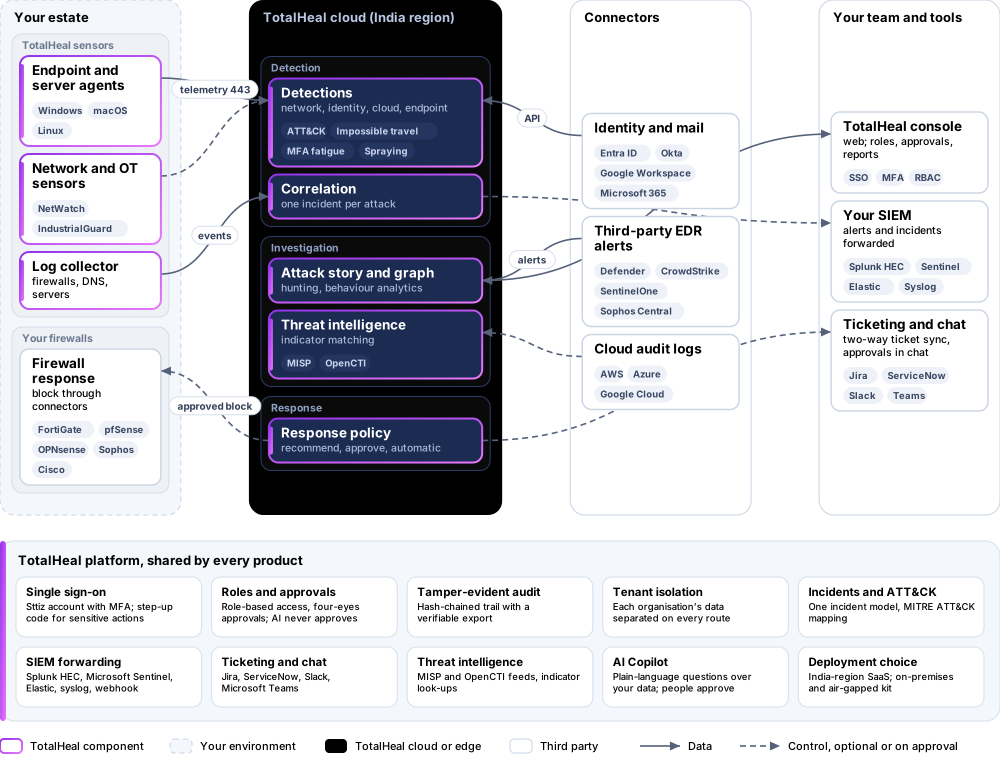
- ConnectAdd any source: TotalHeal agents, the collector or a connector.
- DetectNetwork, identity and cloud rules mapped to MITRE ATT&CK.
- CorrelateAlerts about the same person or host join one incident.
- InvestigateAttack story, security graph and hunting in the console.
- RespondActions run through your response policy and approvals.
Platforms and deployment
Platforms
| Platform | How it is covered |
|---|---|
| Sources | TotalHeal agents, the TotalHeal collector (Linux), API connectors (identity, cloud, mail and third-party EDR alerts) |
| Console | TotalHeal web console |
Deployment
| Profile | Status |
|---|---|
| SaaS | AvailableSingle-region service. |
| On-premises control plane | AvailableDelivered with our team from the on-premises kit. |
| Air-gapped | AvailableOffline kit, offline licence file and offline update bundles. |
Unit and tiers.
Priced per endpoint equivalent per year. Counted: event sources (devices, collectors and connectors) in endpoint equivalents. List prices are not published yet — our team quotes per unit and term.
| Business | Enterprise | |
|---|---|---|
| Correlated incidents, attack story, network / identity / cloud detections | Included | Included |
| Saved searches and scheduled rules | Up to 10 scheduled | Included |
| Full security graph, correlation studio, detection engineering | — | Included |
| Microsoft 365 and Google Workspace email signals | — | Included |
| Price | Contact sales | Contact sales |
Government profile. Government is a profile, not a separate tier or price list: the Elite tier with Government defaults switched on — data residency in India, four-eyes approval of policy changes, a distinct approver for every approval-level action, retention of at least 180 days, and the CERT-In and DPDP reporting clocks.
What you need
- At least one event source: TotalHeal endpoints, the collector or a connector
Procurement documents for ThreatFusion XDR
The datasheet is public. The full dossier is sent on request, so we can match it to your tender.
- Datasheet. What the product does, platforms, deployment profiles, tiers and honest limits.
- Compliance matrix. Each requirement marked comply, partial or no, with an evidence reference — CERT-In directions, DPDP, ISO 27001 controls touched, accessibility of the console, data residency.
- Bill of materials. SKUs per sizing, the unit and quantity formula, customer-side components and services.
- Architecture and hardening. How the product is deployed and the hardening guidance for each component.
- SLA. Support tiers, response targets the team can meet, update cadence and end-of-life policy.
- OEM authorisation letter. A MAF template for resellers and system integrators, with product names exactly as on the SKU.
Works well with
Part of TotalHeal Security Operations suite and of Complete — each product is still licensed on its own.
TotalHealLogIntelligence
SIEM & Log Management
Collect, search and alert on logs from firewalls, DNS servers, servers and identity providers.
TotalHealResponseFlow
SOAR & Automation
Automate response with playbooks — and keep a person in the loop.
TotalHealDNSGuard
DNS Firewall & Security
Stop malware, phishing and DNS tunnelling at the lookup — for every device, on site or on the road.
Get a quote for ThreatFusion XDR.
Tell us how many endpoint equivalents you need and how you want to deploy. We reply with a quote and the procurement documents you ask for.
Or email business@totalhealsecurity.com.