TotalHealThreatTraceEndpoint Detection & Response (EDR)
See, investigate and stop attacks on Linux servers today; desktop EDR is in development.
Trial: 30 days. You sign in to the TotalHeal console with a Sttiz account and activate ThreatTrace EDR. No card.
Servers that run the business — web, application and database hosts — are where attackers mine crypto, plant web shells and move in over stolen SSH keys. Antivirus alone does not show what happened, in what order, or stop it with a record of who decided.
ThreatTrace collects process, network, persistence, file-integrity and sign-in activity on each Linux server, detects attacks mapped to MITRE ATT&CK, joins them into incidents with a timeline, and responds behind your approval rules.
See ThreatTrace in action.
Three in the morning. The CPU on your main web server jumps to one hundred percent, and stays there.
What happens, how ThreatTrace stops it, the steps to roll it out, pricing and deployment — in about 5 minutes. English, with captions.
ThreatTrace EDR, feature by feature.
Server telemetry
Processes, network connections, persistence (services, cron, startup), file integrity of sensitive paths and sign-ins, from the TotalHeal server agent.
Detections that matter on servers
Crypto-miners, web shells, SSH compromise and suspicious persistence, each mapped to a MITRE ATT&CK technique.
Incidents with a timeline
Related detections are joined into one incident with an ordered timeline of what ran, what connected and what changed.
Response with approval
Kill a process, quarantine a file, block an address in the host firewall or isolate the server — automatic, approved or recommended, as your response policy says.
Tamper-evident audit
Every response request, approval and result lands in a hash-chained audit you can export and verify.
A licence of its own
A ThreatTrace licence alone is enough on a Linux server; no desktop agent and no other TotalHeal product is needed.
How ThreatTrace EDR works.
ThreatTrace collects activity on Linux servers, detects the attacks that hit servers — crypto-miners, web shells, SSH compromise — joins them into incidents with a timeline and responds behind your approval rules, with every action on a verifiable audit trail.
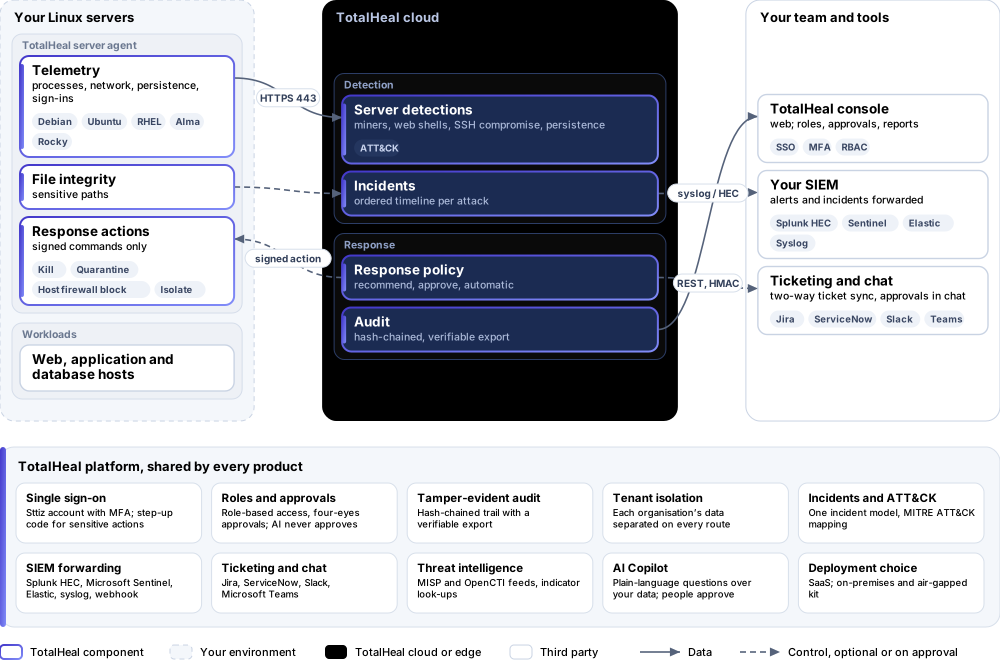
- CollectProcesses, connections, persistence, file integrity and sign-ins.
- DetectServer attack patterns mapped to MITRE ATT&CK.
- CorrelateRelated detections become one incident with a timeline.
- RespondKill, quarantine, block or isolate, as your policy allows.
Platforms and deployment
Platforms
| Platform | How it is covered |
|---|---|
| Linux servers: Debian, Ubuntu, RHEL, AlmaLinux, Rocky | TotalHeal server agent (signed .deb and .rpm packages) |
| Windows, macOS and Linux desktops | In development: not sold for desktops yet |
| Console | TotalHeal web console |
Deployment
| Profile | Status |
|---|---|
| SaaS | AvailableSingle-region service. |
| On-premises control plane | AvailableDelivered with our team from the on-premises kit. |
| Air-gapped | AvailableOffline kit, offline licence file and offline update bundles. |
Unit and tiers.
Priced per endpoint per year. Counted: linux servers with ThreatTrace switched on. List prices are not published yet — our team quotes per unit and term.
| Business | Enterprise | |
|---|---|---|
| Server telemetry, detections, incidents, response with approval, audit | Included | Included |
| Price | Contact sales | Contact sales |
No Business/Enterprise split is set for ThreatTrace yet.
Government profile. Government is a profile, not a separate tier or price list: the Elite tier with Government defaults switched on — data residency in India, four-eyes approval of policy changes, a distinct approver for every approval-level action, retention of at least 180 days, and the CERT-In and DPDP reporting clocks.
What you need
- The TotalHeal server agent on each Linux server
- Outbound HTTPS from each server to the TotalHeal cloud
Procurement documents for ThreatTrace EDR
The datasheet is public. The full dossier is sent on request, so we can match it to your tender.
- Datasheet. What the product does, platforms, deployment profiles, tiers and honest limits.
- Compliance matrix. Each requirement marked comply, partial or no, with an evidence reference — CERT-In directions, DPDP, ISO 27001 controls touched, accessibility of the console, data residency.
- Bill of materials. SKUs per sizing, the unit and quantity formula, customer-side components and services.
- Architecture and hardening. How the product is deployed and the hardening guidance for each component.
- SLA. Support tiers, response targets the team can meet, update cadence and end-of-life policy.
- OEM authorisation letter. A MAF template for resellers and system integrators, with product names exactly as on the SKU.
Works well with
Part of TotalHeal Endpoint Defense suite and of Complete — each product is still licensed on its own.
TotalHealThreatGuard
Business Antivirus (NGAV / Endpoint Protection)
Business antivirus on the TotalHeal agent: stop known malware without quarantining legitimate work.
TotalHealThreatFusion
Extended Detection & Response (XDR)
One incident across endpoint, network, identity, email and cloud — with or without our EDR.
Get a quote for ThreatTrace EDR.
Tell us how many endpoints you need and how you want to deploy. We reply with a quote and the procurement documents you ask for.
Or email business@totalhealsecurity.com.