TotalHealDatasheet · 27 October 2026
TotalHealTrafficShield
Bot management & L7 DDoS
Keep bots, credential stuffing and application-layer (Layer 7) floods off your sites.
- Cloud (SaaS)
- Hybrid
- On-premises
- Air-gapped
The challenge
Public sites and sign-in pages are hit by automated clients: scrapers, credential-stuffing tools and application-layer floods that send ordinary-looking requests until the site slows down or falls over.
The answer
The TotalHeal edge tells people from scripts, protects sign-in pages from credential stuffing and escalates by itself during a Layer 7 flood — with its own browser check, no CAPTCHA vendor in the path.
- Status
- Available
- Deploys as
- Cloud (SaaS) · Hybrid · On-premises · Air-gapped
- Runs on
- SaaS; Self-hosted edge node
- Priced per
- Protected application (FQDN) per year
- Trial
- 30 days
- Licence
- Sold on its own; one TotalHeal console
Supported platforms
- Any HTTP(S) application
- Edge nodex86_64, aarch64, systemd
How it works
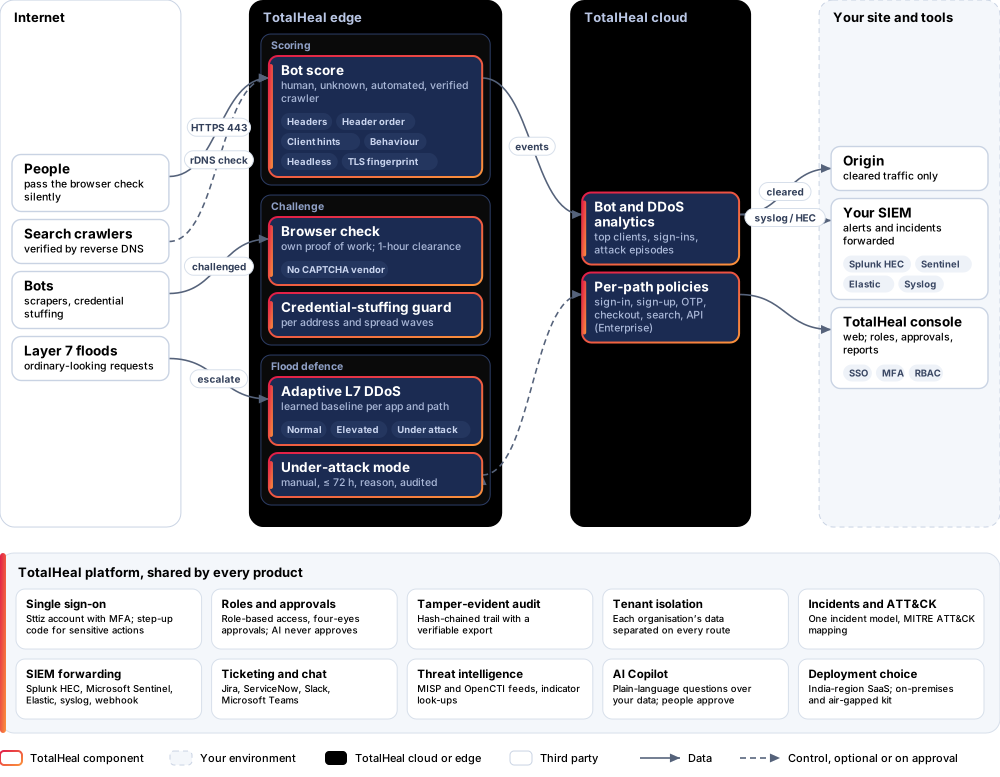
- ScoreEvery request gets a bot score: human, unknown, automated or verified crawler.
- LogBot management starts in log mode; enforcing needs a reason and is audited.
- ChallengeSuspicious clients get the self-hosted browser check; people pass without doing anything.
- EscalateUnder a flood the edge moves from elevated to under attack, then steps down when it ends.
Reference architecture
Key capabilities
- Bot score for every requestHeaders, header order, client hints, behaviour and headless or automation signals (and TLS fingerprints when TLS ends at the edge) give each client a score: human, unknown, automated or verified crawler.
- Verified search crawlersSearch crawlers are verified by reverse DNS; clients that only claim to be a crawler are flagged.
- Own browser check, no CAPTCHAA self-hosted browser check and proof-of-work challenge with no third-party script; a person passes it without doing anything and gets a clearance for an hour.
- Log first, enforce when readyBot management starts by scoring and reporting only; switching an app to enforce needs a reason and is audited.
- Credential-stuffing protectionOne address trying many user names with many failures on a sign-in page — or a wave spread across addresses — is detected, then challenged or blocked.
- Adaptive Layer 7 DDoSA learned traffic baseline per app and path; under a flood the edge escalates by itself from elevated to under attack (every client without clearance is checked), and steps down when the flood is over.
- Under-attack modeTurn on under-attack mode by hand for up to 72 hours, with a reason; it is audited.
- Measured on our test edgeIn our 25 Oct 2026 run, a 70-requests-a-second page flood was challenged 21.6 seconds after it started and none of it reached the site after that; every real browser that was checked during the attack passed on its own; a credential-stuffing replay was flagged after 8 failed sign-ins.
- Alerts next to your other alertsBot, credential-stuffing and flood detections become alerts with MITRE ATT&CK mapping, with bot traffic, top clients, sign-in attempts and attack episodes in the console.
Deployment options
Cloud (SaaS)AvailableNo production point of presence with high availability yet.
HybridAvailableThe installer stays locked until the release key is published.
On-premisesAvailableDelivered with our team from the on-premises kit.
Air-gappedAvailableOffline kit, offline licence file and offline update bundles.
System requirements
Protected platforms
- Any HTTP(S) application
- Edge nodex86_64, aarch64, systemd
On-premises server
- Operating system
- RHEL, Rocky Linux or AlmaLinux 8 / 9; Ubuntu 20.04, 22.04 or 24.04; Debian 11 / 12
- Processor
- 4 vCPU (tested configuration)
- Memory
- 8 GB recommended (6 GB minimum)
- Disk
- 10 GB free for software, releases and backups, plus data
- Sign-in
- Active Directory / LDAP, SAML 2.0 or OpenID Connect
- Software
- Nothing to pre-install: no container runtime, database, web server or Java
Network and access
- The TotalHeal edge in front of your site (TotalHeal point of presence, or a self-hosted edge node on Professional and Elite)
- SaaS: a DNS TXT record and a CNAME for each protected domain; the origin reachable from the TotalHeal edge
Alerts and tickets to
- Splunk
- Microsoft Sentinel
- Elastic
- Syslog / CEF
- Jira
- ServiceNow
- Slack
- Microsoft Teams
Technical specifications
| Features | Included | ||
|---|---|---|---|
| Bot score for every request | Included | ||
| Verified search crawlers | Included | ||
| Own browser check, no CAPTCHA | Included | ||
| Log first, enforce when ready | Included | ||
| Credential-stuffing protection | Included | ||
| Adaptive Layer 7 DDoS | Included | ||
| Under-attack mode | Included | ||
| Measured on our test edge | Included | ||
| Alerts next to your other alerts | Included | ||
| Availability by tier | Essential | Professional | Elite |
| Bot score, verified crawlers, log or enforce, browser and proof-of-work checks | Included | Included | Included |
| Credential-stuffing protection on sign-in pages | Included | Included | Included |
| Adaptive Layer 7 DDoS protection, under-attack mode, attack episodes and history, alerts | Included | Included | Included |
| Per-path bot policies (sign-in, sign-up, OTP, checkout, search, API) | — | Included | Included |
| Self-hosted edge nodes in your data centre | — | Included | Included |
| Threat-actor and campaign intelligence on attacking addresses | — | — | Included |
| List price per application per year | US$2,400 · ₹2,28,380 | US$7,200 · ₹6,85,150 | US$18,000 · ₹17,12,880 |
| Platforms and coverage | |||
| SaaS | Any web application over HTTP(S) behind the TotalHeal edge: verify the domain, point a CNAME at the edge | ||
| Self-hosted edge node | Linux with systemd, x86_64 or aarch64 (Professional and Elite) | ||
| Console | TotalHeal web console | ||
| Deployment options | |||
| SaaS (CNAME to the TotalHeal edge, India) | AvailableNo production point of presence with high availability yet. | ||
| Hybrid (self-hosted Linux edge node) | AvailableThe installer stays locked until the release key is published. | ||
| On-premises control plane | AvailableDelivered with our team from the on-premises kit. | ||
| Air-gapped | AvailableOffline kit, offline licence file and offline update bundles. | ||
| Licensing | |||
| Priced per | Protected application (FQDN) per year | ||
| Counted | Applications configured | ||
| Trial | 30 days | ||
| Government profile | Government is a profile, not a separate tier or price list: the Elite tier with Government defaults switched on — data residency in India, four-eyes approval of policy changes, a distinct approver for every approval-level action, retention of at least 180 days, and the CERT-In and DPDP reporting clocks. | ||
| Procurement dossier | Compliance matrix, bill of materials, architecture and hardening, SLA and OEM authorisation letter, on request | ||
| On-premises server | |||
| Operating system | RHEL, Rocky Linux or AlmaLinux 8 / 9; Ubuntu 20.04, 22.04 or 24.04; Debian 11 / 12 | ||
| Processor | 4 vCPU (tested configuration) | ||
| Memory | 8 GB recommended (6 GB minimum) | ||
| Disk | 10 GB free for software, releases and backups, plus data | ||
| Sign-in | Active Directory / LDAP, SAML 2.0 or OpenID Connect | ||
| Software | Nothing to pre-install: no container runtime, database, web server or Java | ||
| Requirements | |||
| Requirement 1 | The TotalHeal edge in front of your site (TotalHeal point of presence, or a self-hosted edge node on Professional and Elite) | ||
| Requirement 2 | SaaS: a DNS TXT record and a CNAME for each protected domain; the origin reachable from the TotalHeal edge | ||