API Security
Knowing every API you expose, and enforcing what it should accept
Protect API hosts at the same edge that runs WebShield: discovery, schema enforcement and API abuse findings.
Contents
- 1Executive summary
- 2The challenge
- 3Architecture
- 4How it works
- 5Capabilities in detail
- 6Security and data handling
- 7Where it fits
- 8Deployment and system requirements
- 9Technical specifications
- 10Getting started
1Executive summary
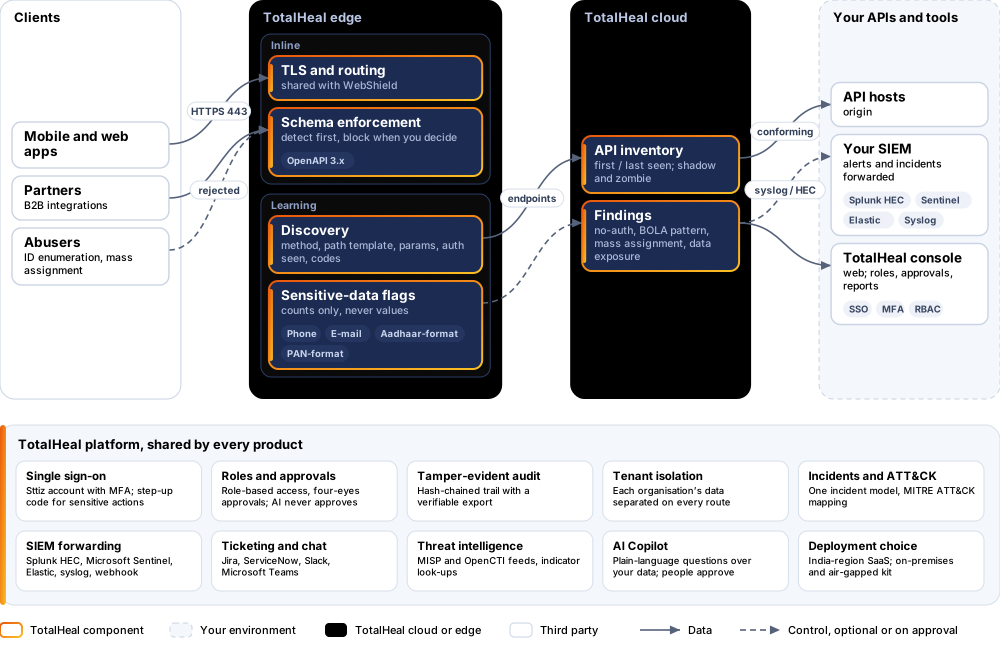
APIShield runs at the TotalHeal edge in front of your API hosts: it learns endpoints from traffic, imports your OpenAPI description, enforces the schema when you are ready and reports API abuse — enumeration, mass assignment, missing authentication — as findings.
2The challenge
APIs now carry most application traffic, and the classic attacks on them — reading other customers’ records by changing an ID, sending fields the client should not set, calling forgotten endpoints — look like ordinary requests to a web firewall.
The TotalHeal approach. APIShield runs at the TotalHeal edge in front of your API hosts. It learns the endpoints from traffic, imports your OpenAPI description, enforces the schema when you are ready and reports API abuse patterns as findings.
3Architecture
4How it works
- DiscoverEndpoints learned from traffic, with first and last seen.
- ImportUpload your OpenAPI 3.x description.
- CompareShadow and zombie endpoints, and findings for review.
- EnforceReject non-conforming requests when you are ready.
5Capabilities in detail
- API inventory from trafficMethods, path templates, parameters, content types, whether authentication was seen and response codes, with first-seen and last-seen dates.
- Shadow and zombie endpointsEndpoints in traffic but not in your specification, and endpoints in the specification that nobody calls.
- OpenAPI importUpload an OpenAPI 3.x description or point to its URL.
- Schema enforcementReject requests that break the imported or approved schema — detect first, block when you decide.
- Abuse findingsUnauthenticated access to endpoints that usually carry authentication, object-ID enumeration from one client, unexpected body fields (mass assignment) and excessive data in responses — shown as findings, not automatic blocks.
- Sensitive data, counted not storedResponses are flagged for personal-data patterns such as phone, e-mail, Aadhaar-format and PAN-format values; only counts are kept, never the values.
6Security and data handling
- Detect firstEnforcement is switched on by you, never by default.
- Counts, not valuesSensitive-data flags keep counts only.
- Findings, not surprisesHeuristics never block on their own.
7Where it fits
8Deployment and system requirements
Protected platforms
- Any HTTP(S) APIOpenAPI 3.x
- Edge nodex86_64, aarch64, systemd
On-premises server
- Operating system
- RHEL, Rocky Linux or AlmaLinux 8 / 9; Ubuntu 20.04, 22.04 or 24.04; Debian 11 / 12
- Processor
- 4 vCPU (tested configuration)
- Memory
- 8 GB recommended (6 GB minimum)
- Disk
- 10 GB free for software, releases and backups, plus data
- Sign-in
- Active Directory / LDAP, SAML 2.0 or OpenID Connect
- Software
- Nothing to pre-install: no container runtime, database, web server or Java
Network and access
- The TotalHeal edge in front of your API host (TotalHeal point of presence or a self-hosted edge node)
Alerts and tickets to
- Splunk
- Microsoft Sentinel
- Elastic
- Syslog / CEF
- Jira
- ServiceNow
- Slack
- Microsoft Teams
9Technical specifications
| Features | Included | ||
|---|---|---|---|
| API inventory from traffic | Included | ||
| Shadow and zombie endpoints | Included | ||
| OpenAPI import | Included | ||
| Schema enforcement | Included | ||
| Abuse findings | Included | ||
| Sensitive data, counted not stored | Included | ||
| Availability by tier | Essential | Professional | Elite |
| API inventory from traffic: methods, path templates, parameters, content types, authentication seen, response codes; OpenAPI export | Included | Included | Included |
| Sensitive data in responses counted, never stored (phone, e-mail, Aadhaar and PAN formats) | Included | Included | Included |
| OpenAPI 3.x import, shadow and zombie endpoints, endpoint review | — | Included | Included |
| Schema enforcement — detect first, block when you decide | — | Included | Included |
| Self-hosted edge nodes in your data centre | — | Included | Included |
| Abuse findings: unauthenticated access to endpoints that usually carry it, object-ID enumeration from one client; accept or reopen | — | — | Included |
| List price per API host per year | US$2,400 · ₹2,28,380 | US$6,000 · ₹5,70,960 | US$12,000 · ₹11,41,920 |
| Platforms and coverage | |||
| SaaS | Any API over HTTP(S) behind the TotalHeal edge: verify the domain, point a CNAME at the edge | ||
| Self-hosted edge node | Linux with systemd, x86_64 or aarch64 | ||
| Console | TotalHeal web console | ||
| Deployment options | |||
| SaaS (CNAME to the TotalHeal edge, India) | AvailableNo production point of presence with high availability yet. | ||
| Hybrid (self-hosted Linux edge node) | AvailableThe installer stays locked until the release key is published. | ||
| On-premises control plane | AvailableDelivered with our team from the on-premises kit. | ||
| Air-gapped | AvailableOffline kit, offline licence file and offline update bundles. | ||
| Licensing | |||
| Priced per | API host per year | ||
| Counted | API hosts configured at the edge | ||
| Trial | 30 days | ||
| Government profile | Government is a profile, not a separate tier or price list: the Elite tier with Government defaults switched on — data residency in India, four-eyes approval of policy changes, a distinct approver for every approval-level action, retention of at least 180 days, and the CERT-In and DPDP reporting clocks. | ||
| Procurement dossier | Compliance matrix, bill of materials, architecture and hardening, SLA and OEM authorisation letter, on request | ||
| On-premises server | |||
| Operating system | RHEL, Rocky Linux or AlmaLinux 8 / 9; Ubuntu 20.04, 22.04 or 24.04; Debian 11 / 12 | ||
| Processor | 4 vCPU (tested configuration) | ||
| Memory | 8 GB recommended (6 GB minimum) | ||
| Disk | 10 GB free for software, releases and backups, plus data | ||
| Sign-in | Active Directory / LDAP, SAML 2.0 or OpenID Connect | ||
| Software | Nothing to pre-install: no container runtime, database, web server or Java | ||
| Requirements | |||
| Requirement 1 | The TotalHeal edge in front of your API host (TotalHeal point of presence or a self-hosted edge node) | ||
10Getting started
- The TotalHeal edge in front of your API host (TotalHeal point of presence or a self-hosted edge node)
Start a 30 days trial in the TotalHeal console with a Sttiz account. For a quote, an on-premises installation or the procurement dossier (compliance matrix, bill of materials, architecture and hardening, SLA, OEM authorisation letter), write to business@totalhealsecurity.com.