TotalHealNetWatch
Network Detection & Response (NDR)
Network detection and response from a passive sensor: beaconing, DNS tunnelling, data leaving, lateral movement and exposed services — no agent on the hosts.
- Cloud (SaaS)
- On-premises
- Air-gapped
The challenge
Printers, cameras, appliances and unmanaged laptops cannot run an agent, and attackers know it. What they do still crosses the network: implants call home on a timer, data leaves in large uploads, and admin protocols move from host to host.
The answer
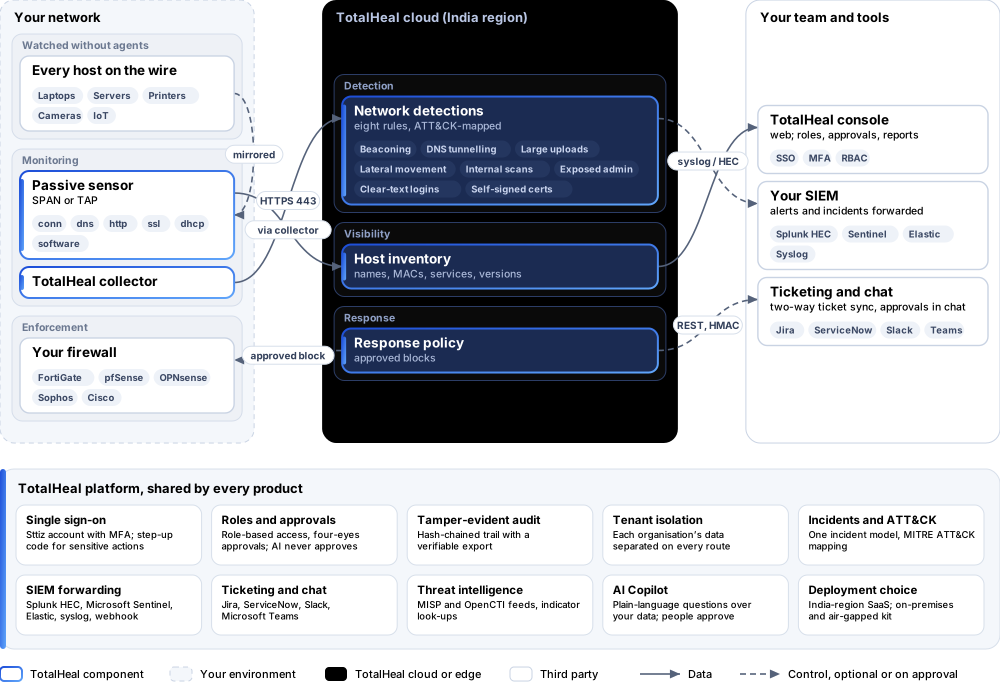
NetWatch runs on the same passive sensor as IndustrialGuard. It reads connection metadata from a SPAN or TAP port, detects command-and-control, exfiltration and lateral movement, learns a host inventory from the traffic and raises alerts in the same incidents as your endpoint, identity and cloud alerts.
- Status
- Available
- Deploys as
- Cloud (SaaS) · On-premises · Air-gapped
- Runs on
- Sensor
- Priced per
- Sensor per year
- Trial
- 30 days
- Licence
- Sold on its own; one TotalHeal console
Supported platforms
- Ubuntu20.04, 22.04, 24.04
- Debian11, 12
- Red Hat Enterprise Linux8, 9
How it works
- MirrorConnect the sensor to a SPAN or TAP port.
- LearnHosts, services and software versions from the traffic.
- DetectEight detections for C2, exfiltration, movement and exposure.
- RespondBlock through your firewall, behind approval.
Reference architecture
Key capabilities
- Passive sensorA Linux host on a SPAN or TAP port; nothing is installed on the hosts it watches.
- Command and controlBeaconing (regular call-backs) and DNS tunnelling.
- Data leavingLarge uploads to outside addresses.
- Lateral movement and scansAdmin services (SMB, RDP, SSH, WinRM) used host to host, and internal scans.
- Exposure and weak protocolsRemote administration reached from the internet, clear-text logins and self-signed certificates.
- Host inventory from trafficNames and MAC addresses (DHCP), services and software versions seen on the wire.
- Response through your firewallBlocking goes through the TotalHeal firewall connectors, behind your response policy.
Deployment options
System requirements
Protected platforms
- Ubuntu20.04, 22.04, 24.04
- Debian11, 12
- Red Hat Enterprise Linux8, 9
On-premises server
- Operating system
- RHEL, Rocky Linux or AlmaLinux 8 / 9; Ubuntu 20.04, 22.04 or 24.04; Debian 11 / 12
- Processor
- 4 vCPU (tested configuration)
- Memory
- 8 GB recommended (6 GB minimum)
- Disk
- 10 GB free for software, releases and backups, plus data
- Sign-in
- Active Directory / LDAP, SAML 2.0 or OpenID Connect
- Software
- Nothing to pre-install: no container runtime, database, web server or Java
Network and access
- A Linux host with a SPAN or TAP port
- The TotalHeal collector
Alerts and tickets to
- Splunk
- Microsoft Sentinel
- Elastic
- Syslog / CEF
- Jira
- ServiceNow
- Slack
- Microsoft Teams
Technical specifications
| Features | Included | |
|---|---|---|
| Passive sensor | Included | |
| Command and control | Included | |
| Data leaving | Included | |
| Lateral movement and scans | Included | |
| Exposure and weak protocols | Included | |
| Host inventory from traffic | Included | |
| Response through your firewall | Included | |
| Availability by edition | Business | Enterprise |
| Passive sensor, eight network detections, host inventory, alerts in incidents | Included | Included |
| Platforms and coverage | ||
| Sensor | Ubuntu, Debian, RHEL-family Linux with a SPAN or TAP port | |
| Console | TotalHeal web console | |
| Deployment options | ||
| Sensor at your site, SaaS console (India region) | AvailableEvents go through the TotalHeal collector. | |
| On-premises control plane | AvailableDelivered with our team from the on-premises kit. | |
| Air-gapped | AvailableOffline kit, offline licence file and offline update bundles. | |
| Licensing | ||
| Priced per | Sensor per year | |
| Counted | Sensors sending to the organisation | |
| Trial | 30 days | |
| Editions | NetWatch is sold on its own, outside the editions. | |
| Government profile | Government is a profile, not a separate tier or price list: the Elite tier with Government defaults switched on — data residency in India, four-eyes approval of policy changes, a distinct approver for every approval-level action, retention of at least 180 days, and the CERT-In and DPDP reporting clocks. | |
| Procurement dossier | Compliance matrix, bill of materials, architecture and hardening, SLA and OEM authorisation letter, on request | |
| On-premises server | ||
| Operating system | RHEL, Rocky Linux or AlmaLinux 8 / 9; Ubuntu 20.04, 22.04 or 24.04; Debian 11 / 12 | |
| Processor | 4 vCPU (tested configuration) | |
| Memory | 8 GB recommended (6 GB minimum) | |
| Disk | 10 GB free for software, releases and backups, plus data | |
| Sign-in | Active Directory / LDAP, SAML 2.0 or OpenID Connect | |
| Software | Nothing to pre-install: no container runtime, database, web server or Java | |
| Requirements | ||
| Requirement 1 | A Linux host with a SPAN or TAP port | |
| Requirement 2 | The TotalHeal collector | |